Oliver Cromwell was a Puritan military leader who rose to power during the English Civil Wars (1642–1651). The first two wars ended with the beheading of King Charles I in 1649. Scotland crowned King Charles II, kicking off a 3rd civil war. Oliver Cromwell subsequently crushed the Scottish opposition, rampaged through Ireland, and ruled with an iron fist as the Lord Protector of Scotland, England and Ireland until his death in 1658.
Importantly for our story, Cromwell displaced his opposition. An estimated 50,000 Irish and 20,000 Scottish men either died in captivity, fled to continental Europe, or were forcibly transported as indentured labour to the American colonies. The principal periods of forced transportation were 1650–1652 for Scottish prisoners, following the battles of Dunbar and Worcester, and 1653–1656 for Irish prisoners, following Cromwell’s conquest of Ireland. It is estimated that between 15,000-25,000 were forcibly transported.
In the 1650s, without being convicted of a crime, you could be captured in battle, arrested or randomly rounded up and held in prison until a merchant agreed to transport you, generally as part of a larger group.
If we assume 15,000–25,000 people transported, in bondage for 5–7 years each, with passage costing £4–£6 per head, and labor contracts selling for £10–£14; merchants may have sold up to 175,000 years of forced labor, generating £250,000 in profit, approximately $100 million in today’s money.
And this brings us to Bryan McClendon…
Indentured Servitude
There is no smoking gun, but there are many reasons to believe that Bryan was transported as an indentured servant between 1653–1655, served 5-7 years in bondage, and married Margery Hunt on gaining his freedom around 1659-1661.
- Bryan was the right age. Bryan was born around 1630. He gave a deposition for a Charles Downs on 27 Mar 1660, in Barbados, which establishes his age. So he was between 20 and 26 years old during the peak years of Cromwellian transportation (1650-1556), and squarely within the age range for military service.
- He was the right ethnicity. His names are Gaelic and, for my money, he was more likely Irish or Scots-Irish, than Scottish.
- McClendon originates from Mac Giolla Fhionntáin – sometimes anglicized MacLindon or MacAlindon – meaning ‘son of the servant of St. Fintan’. This has a Scottish origin but was established in Ulster by the Scots-Irish.
- Bryan is an Irish name, made famous by Brian Boru, High King of Ireland (d. 1014). Although sometimes used in Scotland, its origins are usually Irish.
- Bryan also names ‘Dennis McMarro’ as his kinsman in his will. MacMurchadha and McMurrough are the likely origins of ‘McMarro’ – both are Irish surnames.
- Note: McClendon is never spelled the same way twice. If it was ever written down, it was written by an English speaker making a guess at the Gaelic he was hearing. It is recorded as MacLandins, McLandens, Maclandon, Macklendon, Macklenden, Mackclenden, Maccladland, McLandins and MaceLandon.
- Bryan didn’t come from money. Two things tell a lot about his economic position. He was illiterate and signed with his ‘mark’; and the land he had at his death (22 acres) was roughly equivalent to the land he gained by marrying his wife. It is unlikely he paid for his own transport to Barbados, much less bought land on arrival. More likely, he was brought there.
- There is a plausible timeline.
- In 1653, there were approximately 8,000 indentured servants on Barbados, plus more than 1,000 free Irish former servants. By 1655, half the European population of Barbados were indentured prisoners of war – 12,000 men from Ireland, Scotland and England.
- 1658: Bryan’s wife, Margery Hunt, was unmarried when she inherited her father’s land.
- 1659-1660: We know Bryan’s son Dennis could not have been born much after 1660, based on his own timeline.
- So Bryan probably married Margery between 1659-1660, which he could not legally have done as an indentured servant.
Taken together, Bryan’s age, Gaelic ancestry, illiteracy, modest circumstances, and the scale and timeline of Cromwellian transportation to Barbados, make it most likely that he arrived in bondage between 1653 and 1655 – like thousands of others. But he survived his 5-7 years of servitude – most did not – and his marriage to Margery Hunt gave him a foothold in Barbados as a free man.
St. Philip’s Church Records
We know Bryan lived, owned land and was buried in St. Philip’s parish, but he was most likely not an Anglican. He would have been Catholic or Presbyterian, and non-Anglican marriages and baptisms were not routinely recorded by the state. In point of fact, there are no surviving marriage records of any kind for St. Philip’s Parish until 1672, years after Bryan and Margery would have married. Baptisms did survive, but none are for McClendons.
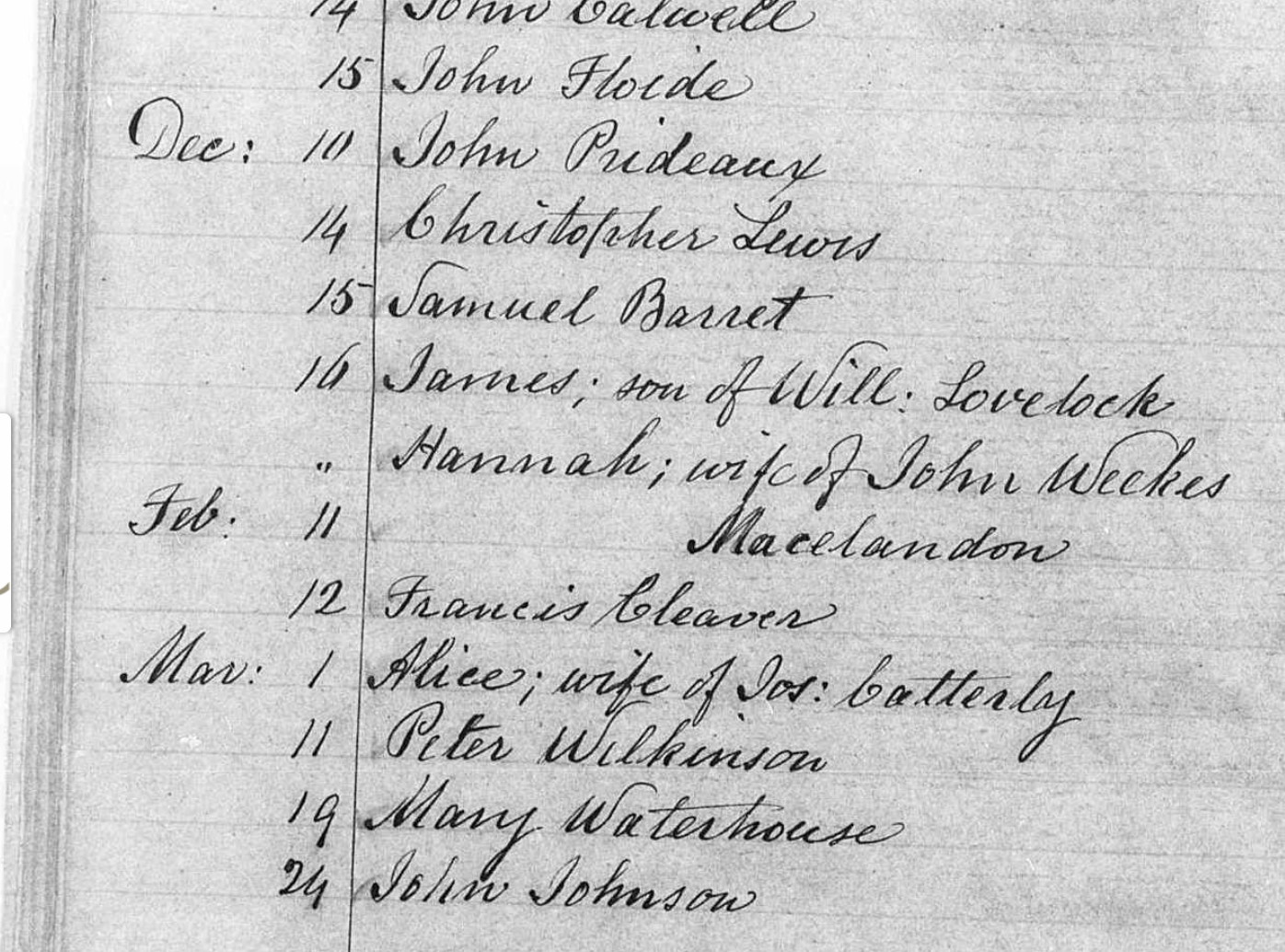
When Bryan wrote his will in 1687, he would have been legally obliged to mention any living children and any living wife, but he only mentions his son and sole heir, Dennis, who had already left Barbados. Bryan was buried by his executor Thomas DuBoys in St. Phillips Anglican Churchyard on 11 FEB 1688, generating the only church record we have for the family.
Where was Bryan’s land?
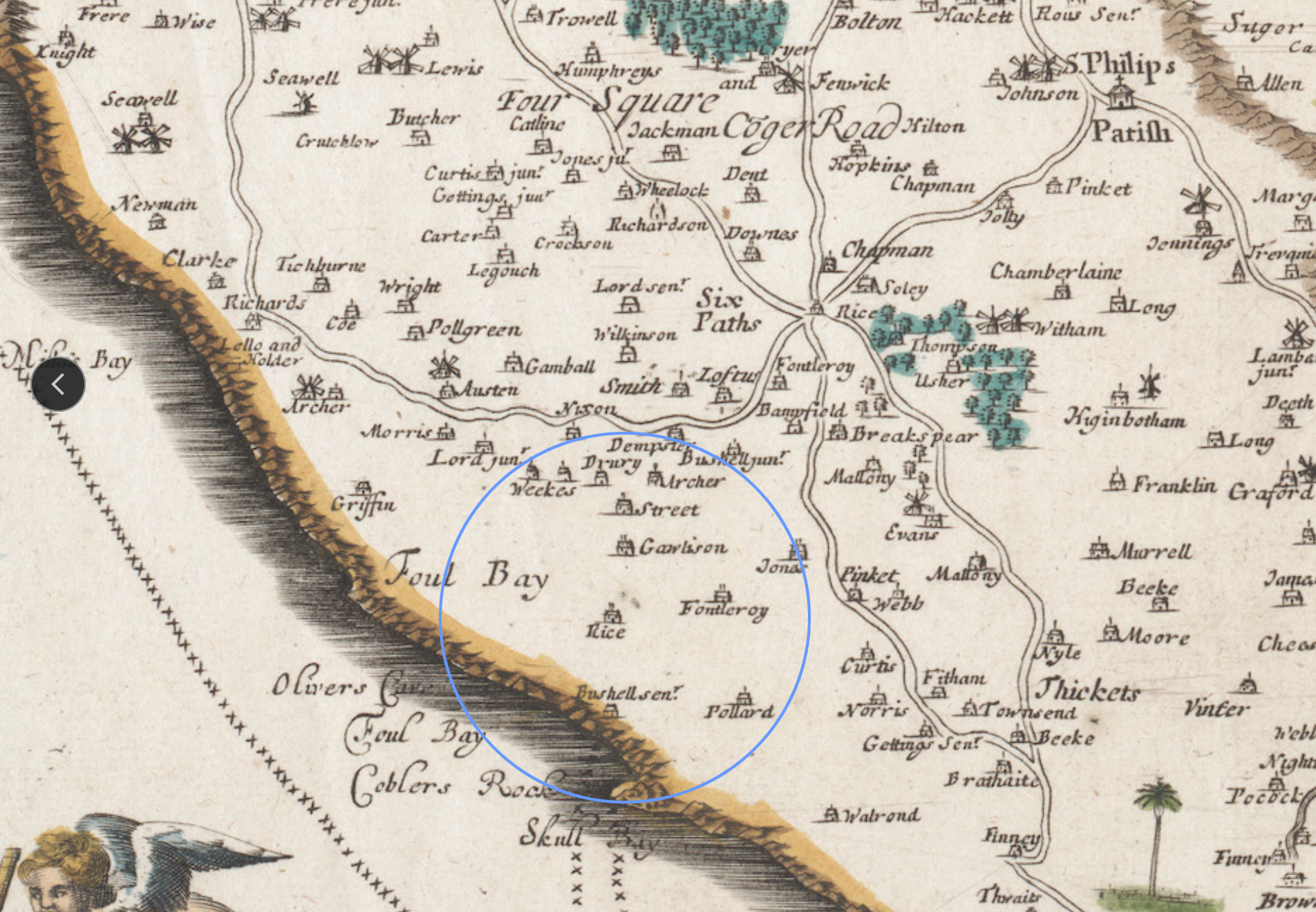
By crossing names from various wills and deeds with an annotated map from 1682, I can make a rough approximation for the location of Bryan’s property.
- Henry Hunt gave land to his daughter Margery in St. Philip adjacent to the land of Farthinando Bushell, Swithing Cane, William Clark, and Edward Woodd.
- Bryan witness the will of Nicholas Rice, originally from Limerick, and he had 2 real estate transactions with him as well.
- Bryan’s own will was witnessed by Geoge Bushell and James Fauntleroy.
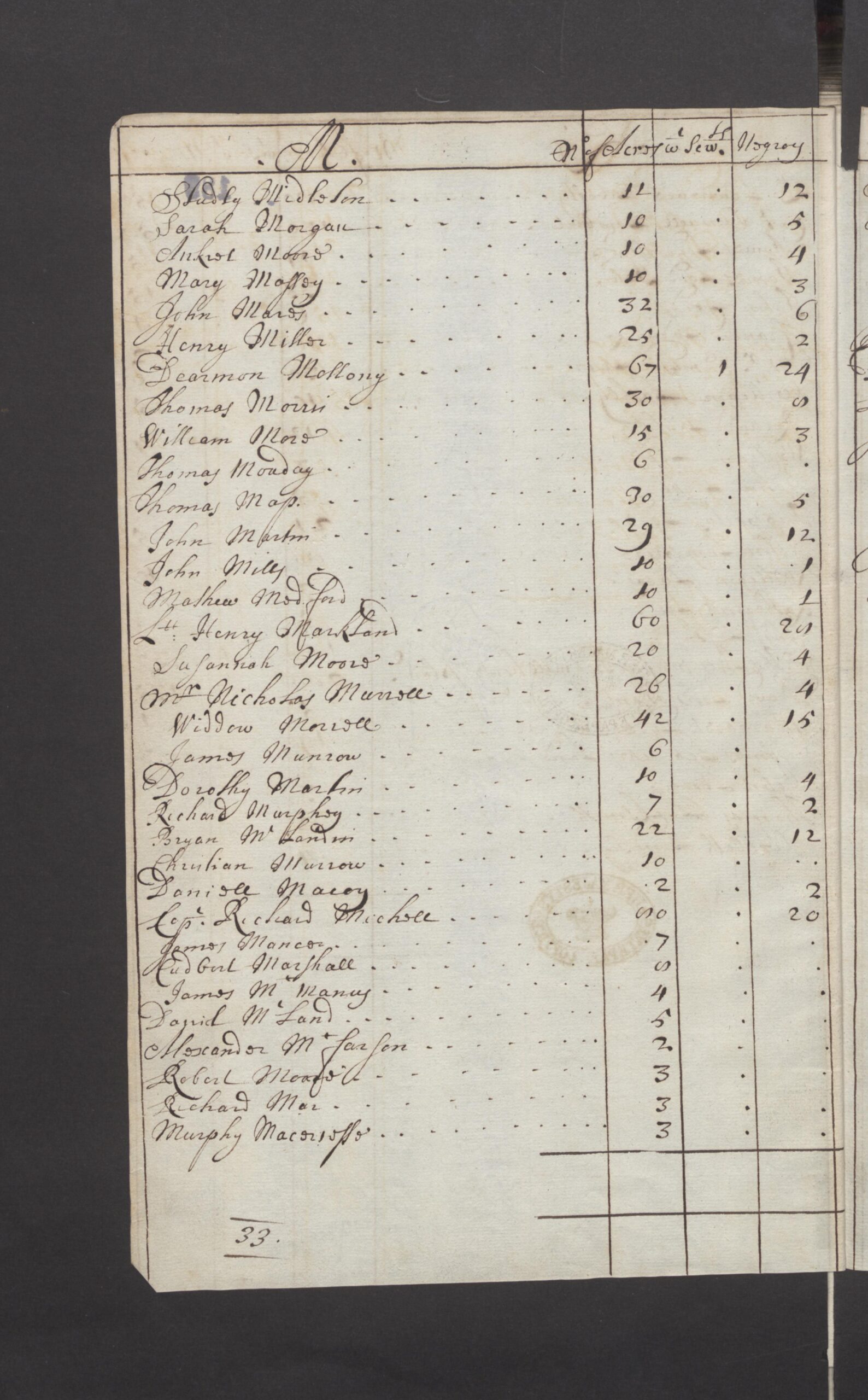
- The 1679 census puts Bryan in St. Philip with 22 acres and 12 enslaved persons.
Those names cluster closely together on the map, so we can reasonably assume they were neighbors – which puts Bryan’s land near what was called and is still called Cobbler’s Point. Keep in mind, the 1682 map is tilted 90 degrees, compared to Google Maps.