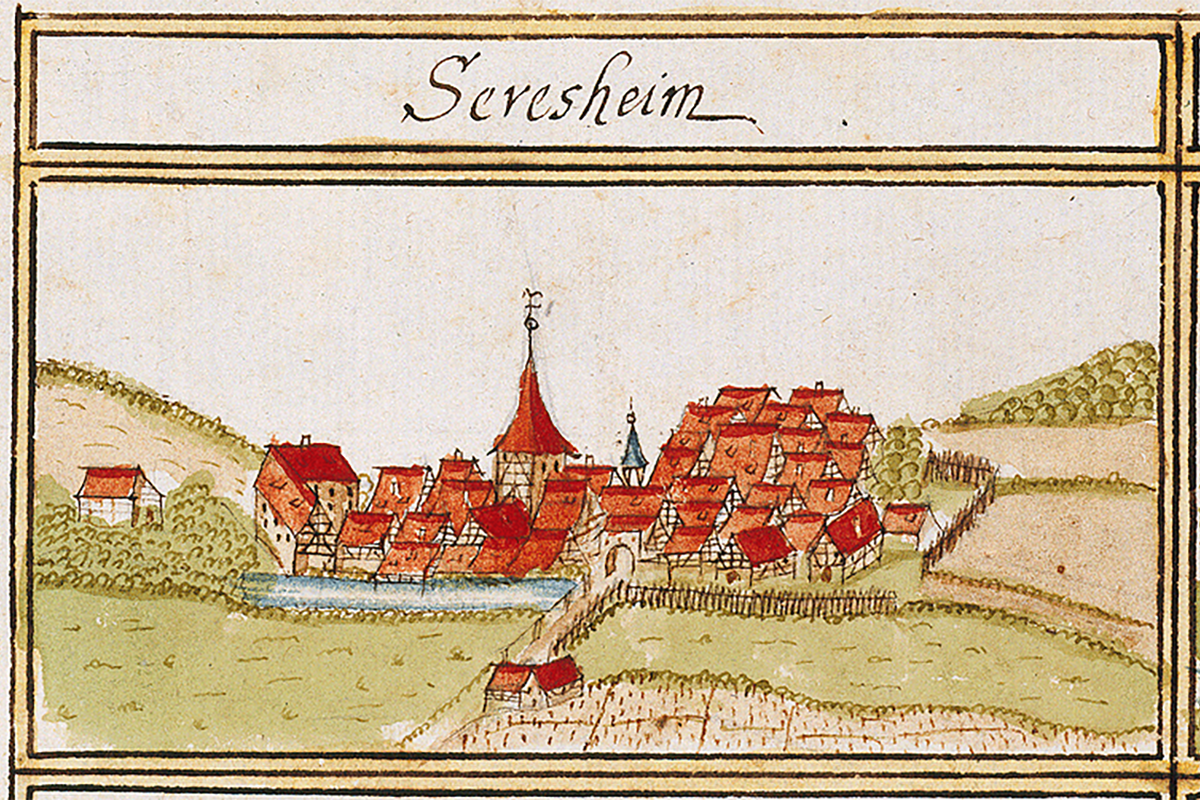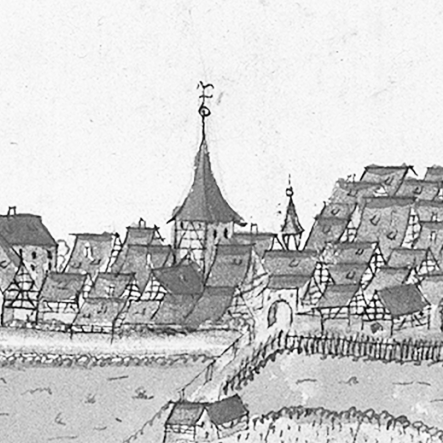
The famine and other plagues. There are almost no complete written accounts from Sersheim, or other villages, in the first half of the 17th century. Mayoral records are entirely lacking and the burial register, which would report death and illness, was only started in 1646 by Pfarrer Hafenreffer. So the baptism book, kept by pastors Scheffer, Dinkelacker, and Portreffer, is the most useful resource.
At the start of the Thirty Years’ War, which began in 1618, Sersheim was fortunate and initially unaffected. It was only after the 1620s that the crop failures and inflation began, bringing starvation to many families.
The price of grain and wine rose quickly and the massive minting of inferior coins led to a currency crisis which seriously damaged the economy of the duchy.
On top of that, the townspeople were soon suffering from gang raids. Soldiers were quartered in the town and, because few provisions had been given, the commanders demanded meals for the soldiers as well.
On September 6, 1634, the Swedes lost the Battle of Nördlingen. That year, the grandson of Endris Schmidt also fell at the battle in Villingen. Shortly after his death, his widow, in memory of her husband, donated a considerable amount to the Poor Box.
The united Protestant troops faced a crushing defeat. Great distress and misery came over Wurttemberg, as the victorious imperial forces occupied the area, behaving barbarically. Theft, murder, rape and fire were rampant and diseases – especially the Black Death – and famine plagued the people. The duke fled to Strasbourg.
Escape to the city. Many villagers fled to the nearest city looking for protection behind the city walls. Farming was no longer possible, that life was no longer safe. The people of Sersheim also fled. They hid themselves in the surrounding woods or sought protection in the nearby city of Vaihingen.
Pastor Dinkelacker, who had been working in Sersheim since 1623, died of the plague on 21 August 1635 in Vaihingen. After that there was no priest in Sersheim for 11 years. When Pastor David Haffereffer arrived at his new parish in Sersheim in 1646, he made a note in the baptismal registry: “Because of sorrowful events, there was no pastor here from 1635 until 1646.”
After May 25, 1634, the entries in Sersheim’s baptismal registry abruptly stop following this notation: “The following children have been baptized by G. Christoff Scheytt, Pastor, in Harrheim and Sersheim.” The community remained orphaned until 1640. No baptism, no marriage, and no worship could be held. The church was devastated and plundered. Windows and doors were knocked down (See chapter: The Evangelical Parish Church).
The next baptism to take place in Sersheim was not until November 12, 1640 when Pastor Scheytt from Harrheim took over the small community, by then down to only a few inhabitants. In 1644, Reverend Scheytt baptized only 4 children, 3 in 1645 and 4 again in 1646 – while in the years before 1634, there were between 15 and 20 children baptized annually in Sersheim. Only after the end of the war did the number of births rise again.
To add to all this misery, the churches were repeatedly ordered to house and feed soldiers. In 1644, the small Sachsenheimer parish was ordered to receive 20 riders from Sindelfingen and to distribute them in the respective villages. A “Church Memorandum” on the subject listed arguments against it, very clearly describing the terrible state of the parish of Sachsenheim, which at that time also belonged to Sersheim.
Ultimately, instead of 26 rations, “only” 16 had to be supplied by the parish: 5 ½ from Großsachsenheim, 3 ½ from Kleinsachsenheim, 4 from Sersheim, 2 from Metternzimmern and 3 from Untermberg. A settlement in money was rejected “since, in some places, early spring sowing needed to get started and what else would preserve the peasantry and the remaining few feudal tenants.”
In 1645, the French commander Turenne made his headquarters in Pforzheim, his vanguard was at Vaihingen on the Enz River. This meant that the surrounding villages, including Sersheim, had a lot to deal with.
A new pastor. In the summer of 1646 Sersheim finally got its own pastor, namely, David Portreffer. This new priest had his hands full trying to help his small congregation. The destroyed church had to be reconstructed and the community life had to be revived.
Fourteen years after it ended, Pastor Portreffer was still dealing with the effects of the war. In the summer of 1662, Hanß Ruopp and his wife appeared at the Parish office to have their nearly grown son logged in the baptism book. “Anno 1645 in the month of May, Hanss Ruopp and his wife Anna had begotten a son, named Hanss … but said son is now grown. ”
Mayor Hanß Conrad Imlin. The new priest was supported by the village mayor Hanß Conrad Imlin. This mayor took office in 1625, when the war had been raging for seven years. However, the worst came after 1634 – as previously described – when the area was plundered and destroyed, and many inhabitants fled. After the war, Imlin had only about 50 people from 25 families in his church. Before the war, there were about 800 souls from approximately 200 families in Sersheim. This parish council chairman had to overcome not only the most severe years of the war, but also undertook the reconstruction of the village at the end of the war. When the laborious work was completed, Mayor Imlin laid down his office in 1660 at the age of 74. Three years later he died. Hans Christoph Winter was the schoolmaster and court clerk between 1620-1632. Whether school was still held in Sersheim during the last years of the war seems doubtful, since at that time only a few children could have existed in the community.
Peace. When a peace was finally negotiated at Münster and Osnabrück, it basically meant a return to the conditions existing prior 1618.
On the August 11, 1650, Sersheim residents also celebrated with a Peace and Thanksgiving Festival. The twins of the new schoolmaster, Johann Jacob Mauch, and his wife Salome were baptized at this celebration.
“These children, however, are more special, sent by God, and then for the glory of God baptized firmly in the peace that God has brought: and therefore they will be called Christiana and Friderica as an enduring memory of the conquering Christ. “
Christina could not enjoy the newly won peace for long. A few months later on June 26, 1651, she died.
New and old citizens working together.After the war, there was a lot of immigration from the southwest, especially from overpopulated Switzerland. New inhabitants came to settle, even in Sersheim, in the last few years of the war and especially after the war. These so-called new citizens joined with the old citizens in rebuilding the village. For instance, Veit Dietrich Baußbach became an established castle owner in Sersheim from 1649 until 1652, or Johann Velentin Schnabel, a former Swedish official from Alsace – he married the widow of Baußbach on 30 January 1653 and lived until 1675 in the Sersheim castle.
Old and new citizens were now faced with the task of eliminating the ruins of the war. Fields laying waste were again newly cultivated. Many vineyards were no longer cultivated after the Thirty Years’ War, but converted to fields and meadows. Damaged buildings had to be renovated, the church had been set up again, and the school system reorganized. As early as 1649 in the Dukedom of Wuerttemberg, general compulsory schooling was required.
In addition to renovating the church, the congregation had to work to raise donations for the necessary baptism and communion artifacts, and ecclesiastical vestments. Pfarrer Portreffer kept a precise accounting of this in the baptismal font. He laid down a list of those treasures and movable objects, “which convey and decorate our true Protestant church and the Augsburg Confession, related and devoted to worship: after the general looting, despair, and destruction of the Duchy of Wurttemberg in 1634, they again have been donated and revered”.
First, in 1649, the community bought a stained common surplice. In the same year, for Christmas, the new owners of the castle, Veit Dietrich Baußbach and his wife Elisabetha,” donated a solid silver chalice covered in velvet and a paten of the same material.” The names of the founders were engraved on the foot of the chalice. In the following years, an altar cloth, a baptismal cloth, and a “skyblue altar and cantal cloth, decorated with gold-silken Börtlin,” were added.
In July of 1653, the Treasury of the Holy was able to buy a hostium and, at Easter, in 1654, Pastor Portreffer and his wife donated a baptismal pot and a baptismal cloth. So the most necessary needs of the baptism, communion and vestments were covered for the time being.
Church and Memorial Petition
- The Lorraine Quartermaster has asked so much of this little village that it has not been able to recover, especially in the fields where mildew did more damage than in other locations.
- The majority of the citizens own no livestock, there is only leased livestock (at the tenant dairies): the town of Metterzimmern has none at all.
- There are many fields and gardens within the district which do not owe tax, rent to be paid in produce, or Hellertax (this refers to the property of the Lords, who do not remit anything to this Office)
- The Bavarian Foragers have done harm to this small parish, by means of fruit and livestock alone, according to a few existing documents, more than 1000 florins. But there was more taken than the records say.
- 6 or 7 Morgens of this parish’s vines were cut down.
- The population of this small parish has diminished, because the inhabitants of Metterzimmern and Untermberg escaped into the fortified city of Bietigheim.
- The town of Großsachsenheim or Amtsstadt, as it is supposed to be, is one of the smallest towns, quite open, and therefore has had to provide quarters for soldiers and contributions; many a man has sold all he has, in order that the poor man, his wife and children can remain at home and not go into bitter exile (as, unfortunately, many have done).
- There is a lot of untilled land here, and most of the property belongs to the wife of the Duke, [See # 3]
- The current load sends many into exile.
- A large error was made in the description of goods in 1627/28, because only the high value of things, not the obligations lying against them, were described. The negligence of the deceased magistrate is to blame, and an appeal has been lodged with the provincial parliament in 1634.
Table of Contents
Foreword 7
Adjustment 8
In the beginning, there was witchcraft 11
Sersheim on the Metterfurt 16
– The Landscape 16
– Conservation and Conservation 31
On the history of the settlement 39
– Prehistoric and Prehistoric Settlements 39
– Settlements from the Neolithic Age 39
– A Roman farmhouse
– Early Medieval Tombs
– The name “Sersheim” 42
A settlement called “Saraesheim” 44
– First documentary mention 44
– The Hirsauer influence and the coat of arms
The Protestant Parish Church 49
– Building history and history 49
– Tomb & Monuments 56
– The Church Struggle 1653-1655 59
The Widdumhof 64
– A rich agricultural estate 65
– The Widdummajer 65
The moving history of the “Castle” 68
– The “Lower Castle” 68
– The “Upper Castle” 73
Feudal Bonds and Emancipation 76
– Controversies about tithing 76
– Various forms of Domination 77
– Spiritual Dominion 78
– Worldly Dominion 79
– Duties & Services 81
Reeve book and Village Law 92
The municipal administration and social history 94
– Around the Town Hall
– The municipality 99
– Poor relief 108
Craft 118
– The mills at Metter 118
– Sersheimer craftsman 123
– A look at the gastronomy 129
– Sersheimer community houses 135
Of Love and its consequences 140
– Browsing the Church Archives 140
– Lighthouses and other teen hangouts (?) 144
– Women and men 148
Childhood and school 156
– School houses in Sersheim 156
– The Beginning of the “Teutschen Schule” 163
– The teachers’ family Belser 167
Crises and Emergencies 176
– The Thirty Years’ War 176
– Emigration wave in the 19th century 179
– The Franco-German War of 1870-71 187
Modern times are breaking: the railway 189
– Railways in the Kingdom of Württemberg 189
– The connection of Sersheim to the railway network 189
The time of great changes 196
– Economic and social developments 196
– The First World War 1914-1918 202
– The Weimar Republic 207
– The Time of National Socialism 1933-1945 222
– Occupation and New Beginning 1945-46 240
Years of construction and the strangers in the village 243
– The consequences of the past 243
– Contemporary witnesses 257
From the fifties to the nineties 264
The painter and honorary citizen Walter Strich-Chapell 269
Index 275